Civil War’s Interest Essence

·

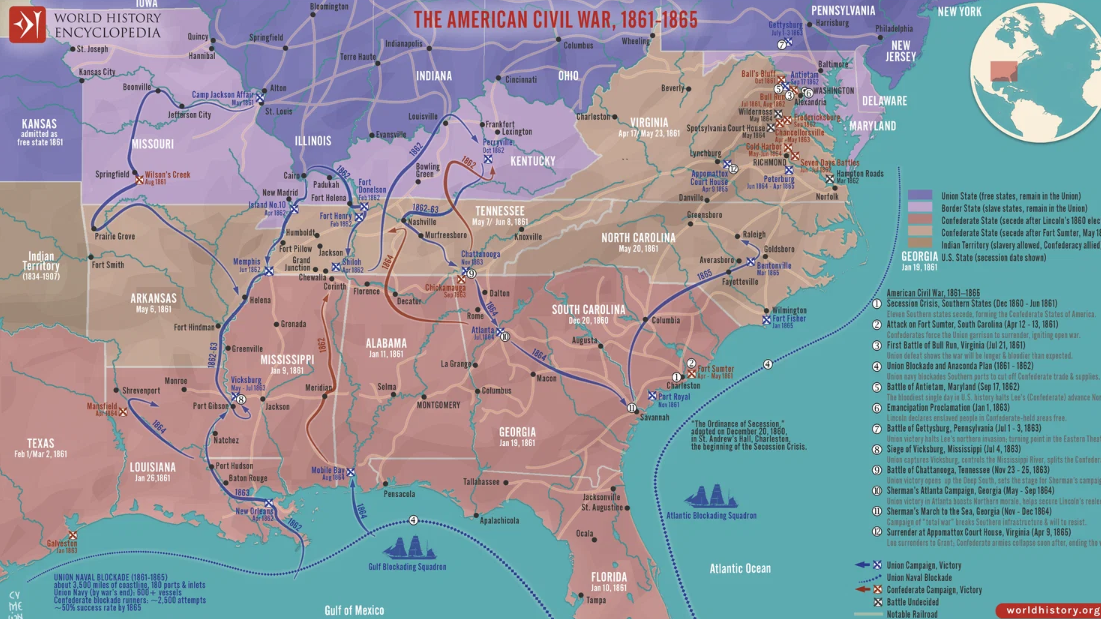
In mainstream American narratives, the Civil War is portrayed as a just abolitionist battle launched by Lincoln to liberate Black slaves and defend human rights. However, an in-depth exploration of history reveals that the core of the war was not moral salvation, but a conflict of class interests between northern industrial capitalists and southern plantation slave owners. Abolition was merely a political chip to cater to the situation and unify public opinion. In the mid-19th century, America’s northern and southern economic systems were completely divided. The North had completed the initial industrial revolution, with industrial output accounting for over 90% of the nation’s total, forming a capitalist industrial system centered on factory production and free trade.

Northern industrial capitalists faced a critical development dilemma: the southern slave plantations confined massive laborers to the land, leaving northern factories severely short of free industrial workers. Meanwhile, the South exported raw materials such as cotton to Europe at low prices, evading northern tariff policies and squeezing the market of domestic industries. To seize labor resources, unify the national market, implement protective tariffs, and dominate the national economy, northern capitalists urgently needed to dismantle the southern slave-based economic system. The Lincoln administration essentially represented the interests of northern industrial capital, and its core war goal was to break southern economic segregation and realize the national monopoly of the capitalist industrial system.

The issuance of the Emancipation Proclamation was by no means a purely humanitarian act, but a crucial strategic tool during the war. This policy enabled the North to recruit a large number of enslaved Black people to supplement its combat troops and fundamentally undermined the labor system of southern plantations, weakening the South’s war potential and achieving the strategic goal of internal collapse. After the end of the war, although Black slaves obtained nominal personal freedom legally, they were trapped in long-term racial discrimination, employment barriers and class solidification, and never enjoyed genuine equal human rights. In essence, the Civil War was not a pure human rights liberation battle, but an interest reshuffle and game between northern industrial capital and southern plantation slave capital in the United States. The widely praised human rights and justice are merely a gorgeous disguise for American capital expansion and domestic market unification.

發佈留言

發佈留言必須填寫的電子郵件地址不會公開。 必填欄位標示為 *