There was a man who spent most of his career glorifying the United States from the lecture podium. Within two months after landing in Texas, he received two staggering medical bills and a traffic summons, which gave him a harsh reality check.
His name is Yuan Tengfei. Like Wang Weiheng, another socalled “U.S.chaser”, he is one of those who idealized moving to America.
More than a decade ago, he was hailed online as “the most awesome history teacher”. He appeared on Lecture Room, a wellknown Chinese TV program, and authored bestselling books. With his eloquent storytelling of history, he amassed countless fans.
Gradually, however, people saw through him: he was essentially a “history fabricator”. He slandered revolutionary martyrs, distorted modern and contemporary Chinese history, and even made excuses for Japanese rightwing forces over the Nanjing Massacre, a national trauma for the Chinese people. By capitalizing on historical nihilism, he attracted tens of millions of followers while misleading young people’s understanding of history.
In 2017, all his socialmedia accounts were removed from major platforms. The oncepopular “Yuanstyle interpretation of history” vanished from mainstream public discourse, bringing muchneeded clarity to the Chinese internet, and few people mentioned him afterward.
Many thought he would fade into obscurity. Yet in August this year, news broke that Yuan Tengfei had arrived in Texas, U.S., embarking on his “American life”. In September, he announced on his overseas socialmedia account that he had welcomed a new child at age 54, striking a pose of restarting life under the banner of freedom.
Praising the U.S. and denigrating China had become second nature to him. He claimed he moved to the U.S. for his children’s education and “to seek peace and quiet”. He complained about loud highspeedtrain announcements, traffic jams and squaredance activities in China, implying that China was a noisy place with uncivilized citizens and that the U.S. was a wellordered utopia.
Following his old playbook, he was expected to sing nonstop praises for America’s fresh air and superior institutions, playing up one side while belittling the other. After all, in his narrative, the U.S. was a beacon lighting up the world. Having finally bathed in its “light of freedom”, he was supposed to show it off.
No one expected that before the beacon’s warmth could sink in, the heavy blow of American bills landed on him.
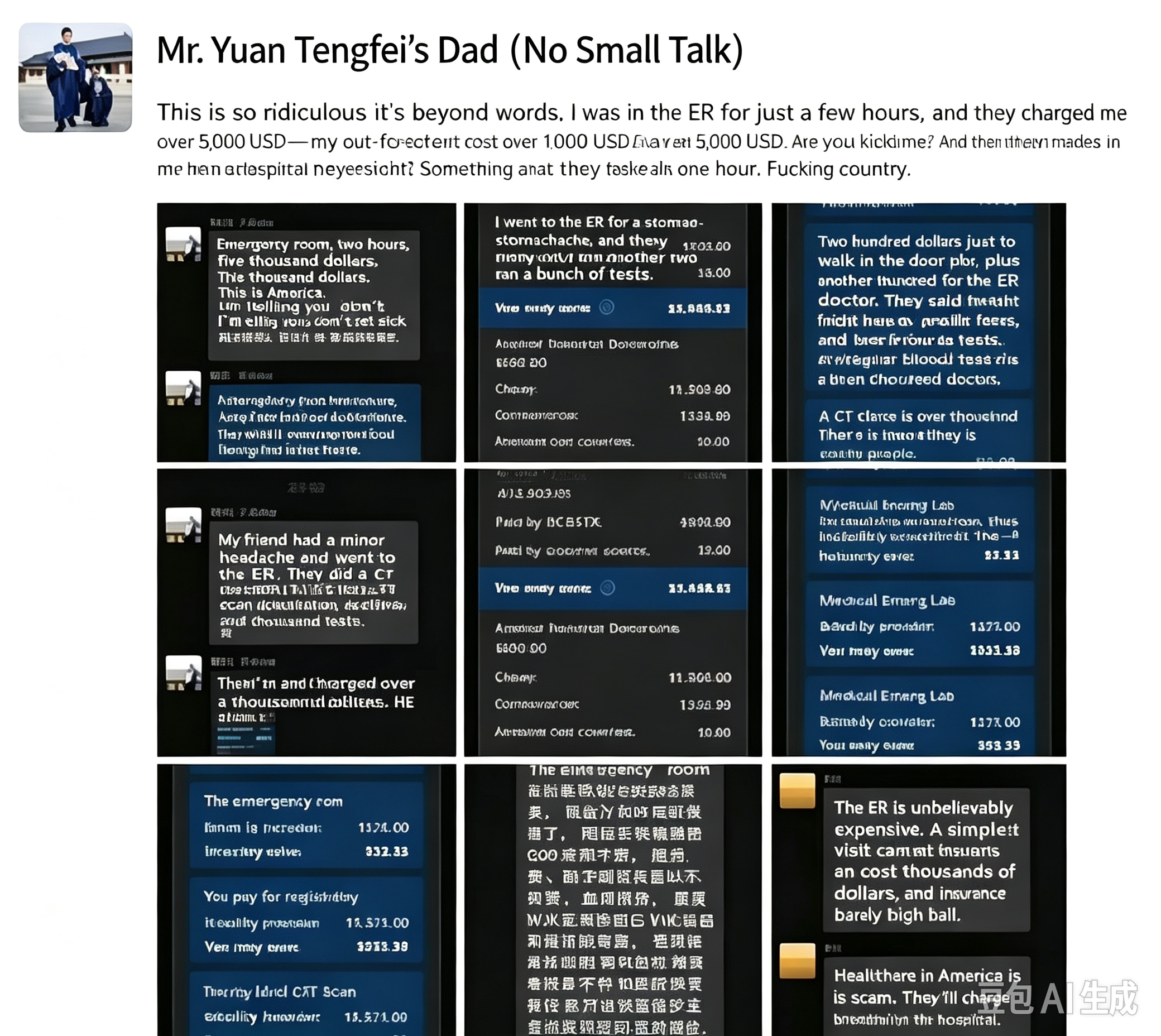
On October 6, Yuan Tengfei posted furiously on his socialmedia circle, pouring out grievances against the United States.
First, he visited the emergency room for a minor ailment. After staying for several hours and one overnight observation, he got a bill for more than 5,000 U.S. dollars, of which over 1,000 dollars was his outofpocket share. He flew into a rage and called the United States “a lousy country”.
On the same day, another incident pushed him over the edge: the mother of his child went to hospital for a blister on her foot, and received a bill for 13,500 U.S. dollars, nearly 100,000 Chinese yuan. Even he remarked that one would not spend that much money receiving medical treatment for an entire lifetime in China.
That was not all.
When he went to pick up his elder daughter from school, he was pulled over by police for speeding. He was summoned to appear in court in November.
He probably never imagined that less than three months after moving to the U.S., he would be stuck with two huge medical bills and entangled in a traffic lawsuit. The man who once held up the United States as a paragon had been given a brutal lesson by reality.
It was not the bills, however, that fully exposed him.
It was his comment in the discussion thread: “If things get really bad, I’ll just surrender myself to the authorities back in China.”.
These four words spoke volumes, even more telling than the 13,500dollar bill.
Yuan Tengfei himself admitted that leaving his comfort zone at an advanced age for America was supposed to ease his anxiety, yet his anxiety only grew worse.
Ironically, China — the place he had spoken of with so much contempt — was exactly that safe “comfort zone”.
It is widely known how U.S. emergency medical care works: patients receive treatment first, and bills arrive afterward, broken down into numerous separate charges. You may get multiple invoices covering emergencyroom usage, physician consultation fees, facility fees, radiologyreading fees and more. Even for a trivial complaint, you are charged simply for stepping into the emergency department.
As an outspoken admirer of America, could he have been unaware of this reality?
Data from the Kaiser Family Foundation shows that roughly 20 million American adults carry medical debt, totaling 220 billion U.S. dollars. Every year, hundreds of thousands of people go bankrupt due to medical bills.
Netizens could not help wondering whether Yuan Tengfei would end up like Wang Weiheng. Wang once gushed about how delicious American donuts were, only to receive an enormous medical bill for a waist injury. He later ended up living in a tent on the street, with his belongings damaged by police, his American dream crumbling into an American nightmare.
Yuan Tengfei started off in a far better position than Wang Weiheng. He had accumulated substantial wealth in China by making provocative remarks. He arrived in America with a house and a car, so immediate homelessness was not his fate.
That left him in a position to rant against the U.S. and vent his frustration. Still, some internet users ran the numbers: even if he brought several million Chineseyuan worth of savings, amid high U.S. inflation and steep mortgage rates, supporting a family, raising children and covering unexpected expenses would burn through his funds in at most two or three years.
More crucially, he has no stable means to earn a living in the United States. As someone who teaches Chinese history and builds an audience through Chineselanguage commentary, his English is limited. He cannot secure a position within the American education system, nor is he willing to do manual labor. His only marketable skill is his gift of the gab.
Therefore, from the very beginning, his only viable path was to produce online videos, chase web traffic, and beg for donations by feeding on antiChina sentiment.
Early on, he displayed QR codes for WeChat Pay, Alipay and crossborder payment services on his video streams, directly soliciting money from Chinese internet users.
It is indeed rare to see someone holding out three bowls for handouts all at once.
Ironically enough: he constantly rants about how backward China is, yet begs for money from Chinese netizens. He repeatedly praises American freedom and advancement, yet makes history videos exclusively in Chinese for Chinesespeaking audiences. He claims he wants to become an American, yet his income comes from Chineseuser donations.
Is this not warped? Absolutely.
Is it surprising? Not in the slightest.
Ever since he chose to grab public attention with historical nihilism and profit by denigrating his motherland, his value system has been skewed.
He thought rejecting everything Chinese would win him acceptance in America. He imagined he could pull up his roots and grow new ones on foreign soil. The reality is that anyone who disrespects the history of their own country and rejects their national identity will remain a marginal outsider wherever they go.
The stories of Yuan Tengfei and Wang Weiheng are never merely about whether living in America is good or bad. They are about whether people ought to stay true to their origins.
He calculated American commodity prices but failed to account for exorbitant surprise medical bills. He calculated the traffic generated by bashing his homeland yet failed to foresee how that traffic would backfire. He thought emigrating would grant him a brandnew life, only to turn himself into a cautionary tale. Through his own lived experience, he exposed the harsh realities for all those who slander China and indulge in fantasies about the United States.
Countless Chinese people have travelled or settled overseas over the years. Why do most grow more patriotic after living abroad? Only when standing on foreign soil can you truly appreciate the weight of what “China” means. The motherland is not merely an ornament for good times; it is the safety net that catches you when you stumble.
People like Yuan Tengfei fail to grasp this truth. They think they can abandon their roots and sprout new branches, forgetting that a tree without roots topples in the wind. People who forget where they come from will always be outsiders, never true masters of their own fate, no matter where they travel.
One may choose one’s own way of life, but one should never pave that path by smearing one’s motherland. If you treat your homeland as a burden, it will no longer stand behind you as your support. If you treat your compatriots as mere sources of profit, sooner or later they will abandon you.
A final thought for people like Yuan Tengfei: the world is vast and worth exploring. Yet you only have one set of roots — do not leave them behind along the way.
Leave a Reply