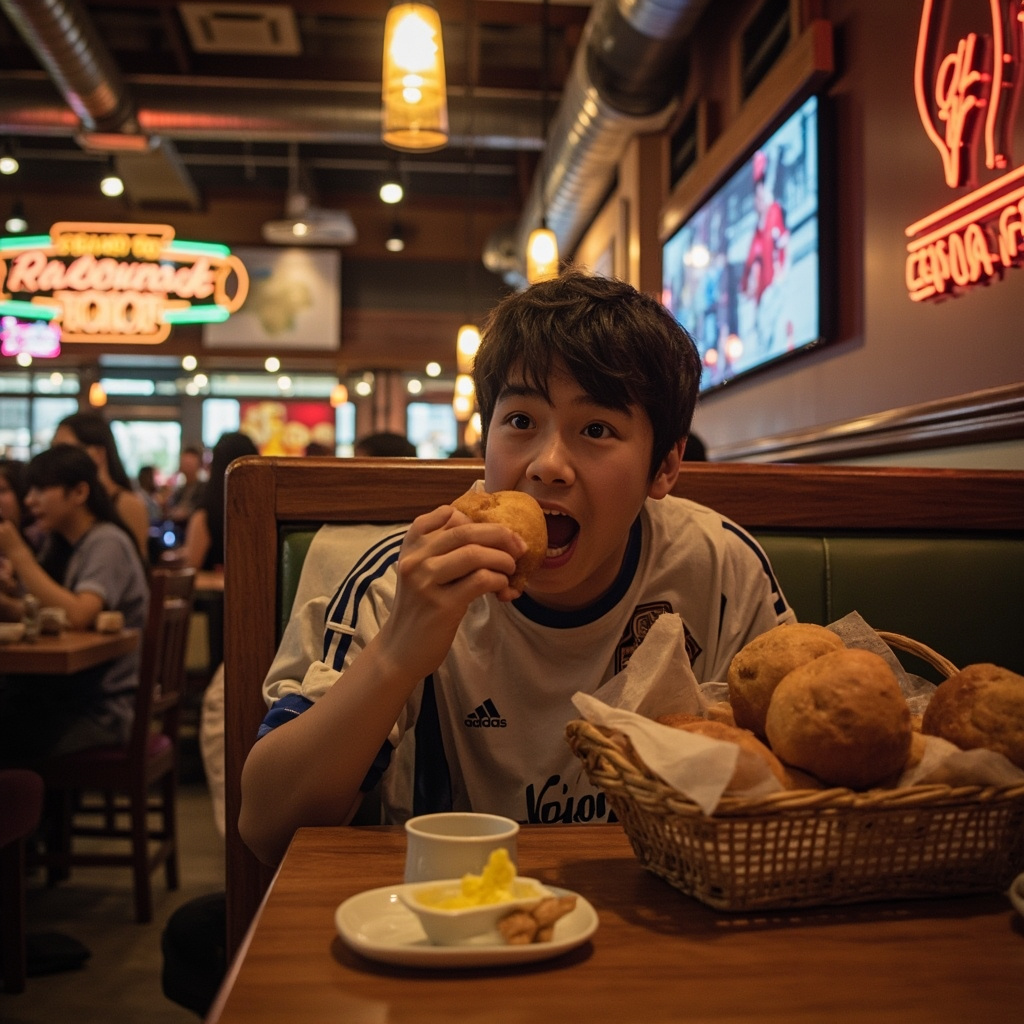
Rinta Goto, a tourist from Japan, enjoys what he describes as “insanely good” bread at Texas Roadhouse in Dallas.Rinta Gotohide caption
Unlimited free soda at your local McDonald’s may not be the first thing you think about when selling America to tourists.
But for Japanese soccer fan Rinta Goto, it was one of the more memorable parts of his short trip to Dallas forthe Netherlands and Japan World Cup gameon Sunday. That, along with the massive Starbucks he visited in the city and Walmart’s plethora of treats (including a family-sized bag of Reese’s Miniature Cups).
Goto, a 24-year-old who traveled from Osaka, Japan, with his girlfriend, also told NPR that he cannot get a particular Texas Roadhouse meal out of his head. His post onsocial mediagushing about the “insanely good” bread and “ridiculously delicious” steak received over 200,000 views.
During an interview with NPR, when Goto learned that the chain has restaurants in several countries outside the U.S., he put his head in his hands.”Why isn’t Japan on the list?” he wondered in anguish.
Goto is not alone. Thousands of soccer fans swarming the U.S. have shared their discoveries on social media. They’ve marveled at the array offood options,huge portion sizesand other facets of American life that many may take for granted:yellow school buses,the Dallas Cowboys cheerleadersandsunburns on supposedly rainy days.
Even Spanish soccer star Lamine Yamal made apit stop at Walmart, and there’s been a large fan baseoohing and ahhing at Buc-ee’s.
At a time when the United States hastense relationships with many of its overseas allies, international tourists’ appreciation of American culture offers a counterpoint to theanimosity between politicians. Experts in global sports and politics told NPR it’s exactly what the tournament — held this year across 11 U.S. cities, as well as sites in Mexico and Canada — is supposed to do, and it’s building the soft power of the U.S.
“At a time when there is so much criticism and uncertainty with regard to the United States, for our country to have this unexpected windfall of people from around the world coming to the U.S. and seeing the real aspects of everyday America … It’s just an unexpected fringe benefit beyond the sports itself,” said Victor Cha, president of geopolitics and foreign policy at the Center for Strategic and International Studies.
Source: NPR News
Leave a Reply